The founding question of the Nexus Research Group, how do you do authentic science with nothing, has driven three decades of original work in low-cost science instrumentation, sensors, and data acquisition. These projects make authentic, hands-on science and mathematics affordable in any classroom. As AI-generated data becomes harder to trust, first-hand measurement from real, low-cost instruments matters more than ever.
Casio calculator data logger, remote control, IMC simulator and more for $10
Ultra-low-cost upgrades for Casio FX-9750 & FX-9860 . 2025 to 2026
A novel RECEIVE() timing discovery and encoding method transforms Casio graphing calculators into timed interval data loggers and more. Transform a tool students already own for use in maths, science, physical education, horticulture, and the new industry-led subjects - they own it, they use it, at home, on marae, on holiday! A priority disclosure is archived on Zenodo. NEW! Restore Hasbro Smart R2D2 remote control using a calculator...
The famous B9 robot from 'Lost in Space' comes to school! A walking, talking, AI-enabled mobile science laboratory built to engage STEM learners. It supports RIGEL and digital multimeter sensors, broadcasts live data as web-served graphs, and speaks any language. B9 has songs about the fun and creativity of science - sing along!
RIGEL: the Real-World Interactive Games and Electronics Link
Invented by subverting game design software . updated 2025
A universal sensor interface that connects wearable and environmental sensors and microcontrollers to real-time data logging and game control. RIGEL can plot live graphs, control robots, and let a student fly a virtual island using an exercycle.
Browser version: RIGEL-WEB, a self-contained single-file HTML port.
SMART: the Sound-to-Motion Analysis and Recording Tool
Self-contained browser instrument . 2026
A free, single-file HTML instrument that turns the audio system in any school device into a precision timer and spectrum analyser for physics, with a built-in simulator so every experiment works without hardware.
Citizen science and authentic cross-curricula learning
Inexpensive digital multimeters, paired with home-made sensors costing a few cents, turn any classroom into a data-logging laboratory for science and mathematics.
Using accessible game engines, learners integrate coding, science, mathematics, art and music into real-world projects, including a 2025 human and AI creative partnership experiment.
A maker-science pedagogy in which learners build their own instruments and props, understand measurement by constructing it, and investigate questions that matter to them. It applies the Build it, Test it, Use it pedagogy.
Design by Subversion: the framework behind the inventions
Working framework, not yet peer-reviewed
The constraint-driven methodology identified across this body of work: turning hard constraints into the design brief by exploiting the unintended affordances of existing tools, systems, and institutions. It is the common thread linking these projects.
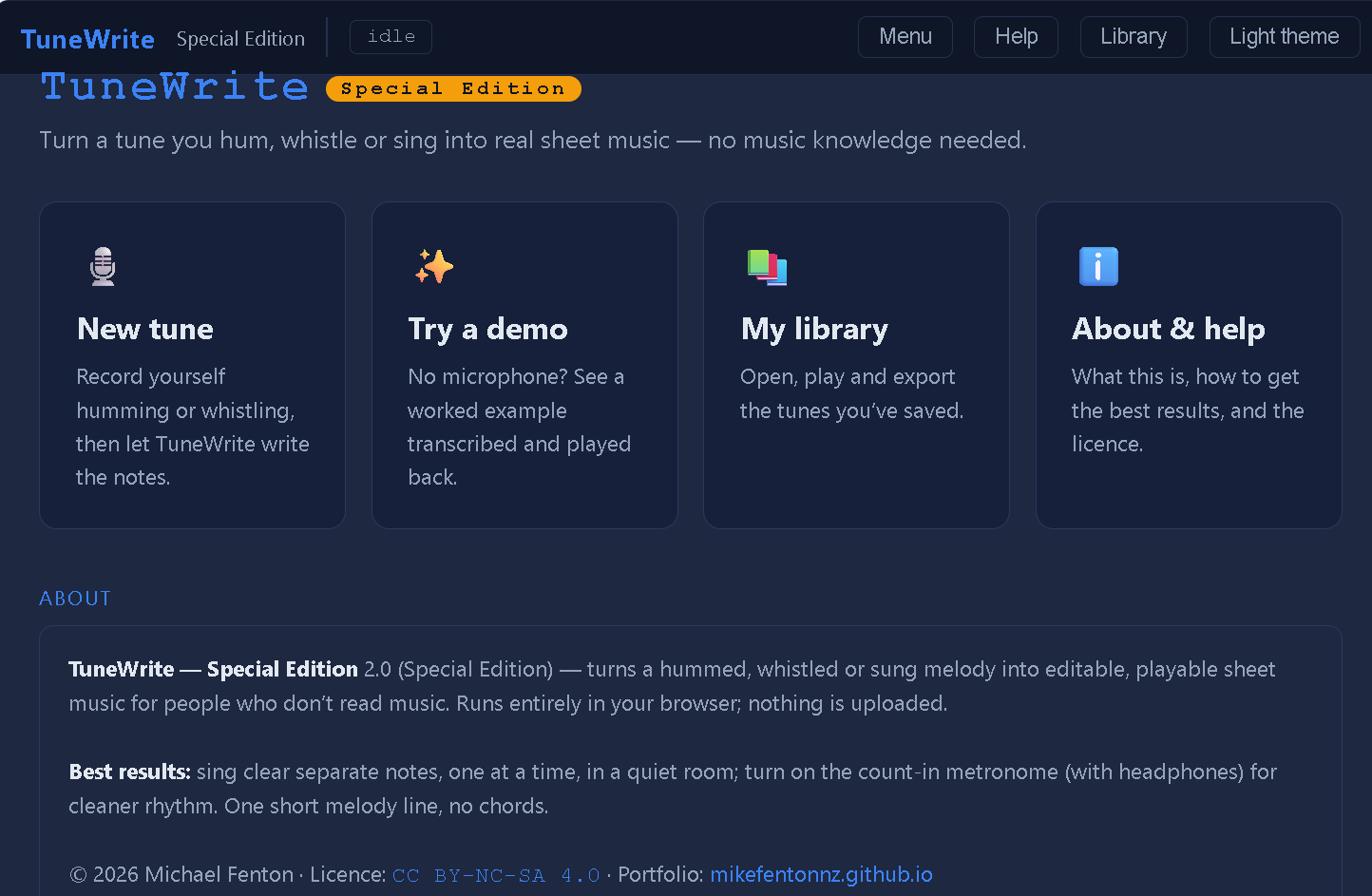
TUNEWRITE - A combined 'Design by subversion' and 'AI as partner' tune writer experiment. How do you get learners started on a complex task, one with a high ceiling for entry? Most teachers and learners would give up. Take a music example.
How do I share an earworm tune my brain spontaneously generated and won't let go with my singer/composer daughter? I can't read or write sheet music; AI could assist me create a tool that fills this gap. A gap that that once filled inspires me to learn more and create more music as a result.
AI use in education should not be seen as a binary good or bad choice, or dismissed as removing learners need or desire to think for themselves. My experiments with RIGEL, SMART, GraphX and ChemX (the new Graph Explorer and Chemistry Explorer HTML apps) model what learners could achieve given guidance.
TuneWrite - by Michael Fenton, 2026. A combined 'AI as partner' and 'Design by subversion' education research projec TuneWrite (a tune writer browser-based application) turns a sung, hummed or whistled melody into readable, editable, savable sheet music for someone like me who cannot read or write music notation. t.